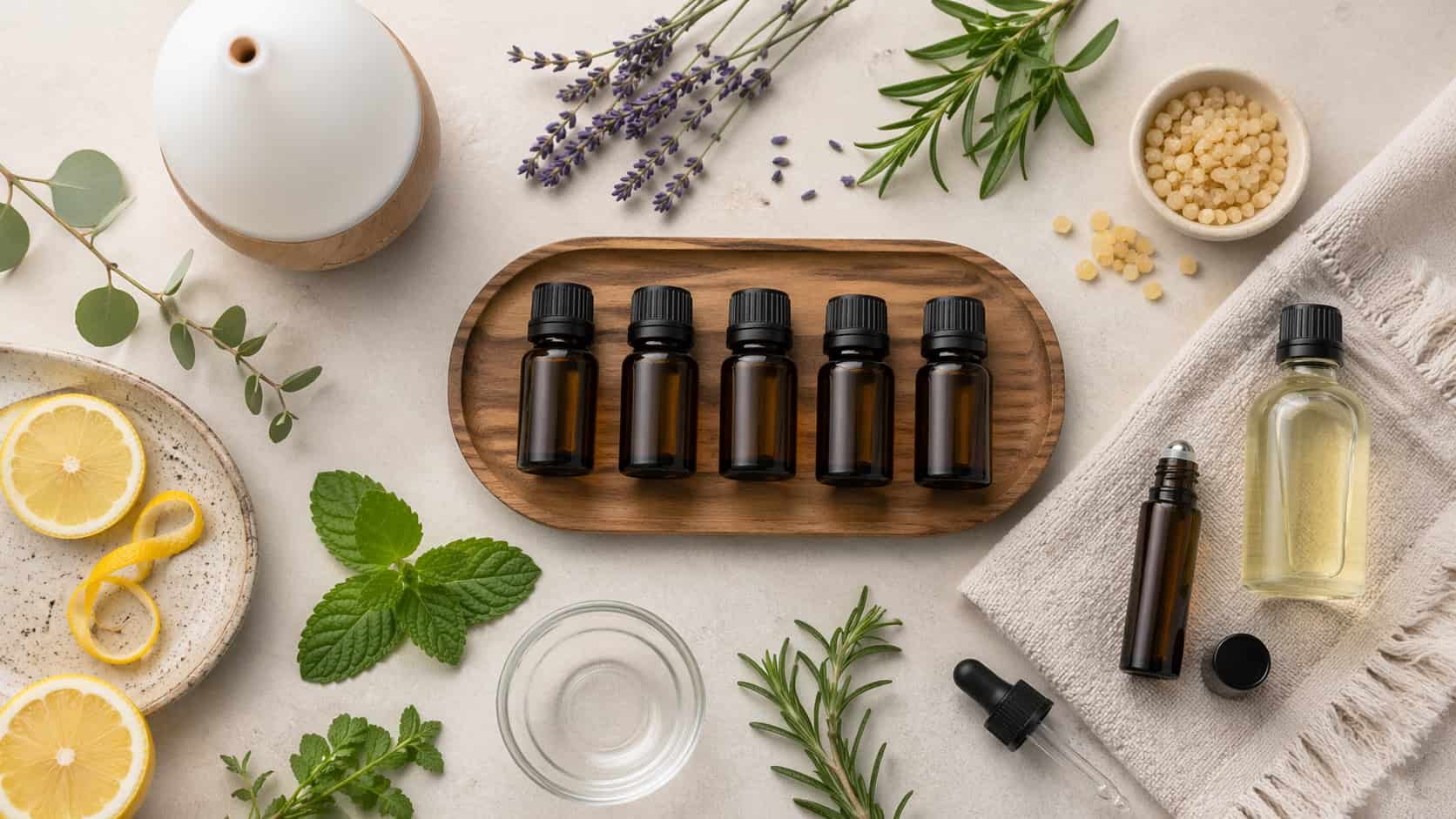
If you’ve ever walked past a lavender field, peeled an orange, or crushed a sprig of rosemary between your fingers, you’ve already experienced essential oils. They’re the concentrated aromatic compounds that give plants their distinctive scents, and people have been using them for wellness, cleaning, beauty, and emotional support for thousands of years.
But getting started with essential oils can feel overwhelming. There are hundreds of oils, dozens of brands, conflicting advice about safety, and a lot of marketing hype to sort through. This guide cuts through all of that. By the time you finish reading, you’ll understand what essential oils are, how to use them safely, which oils to start with, and how to avoid the most common beginner mistakes.
No sales pitch. No pseudoscience. Just practical information you can start using today.
What Are Essential Oils, Exactly?
Essential oils are highly concentrated plant extracts. They’re produced by steam distilling or cold pressing flowers, leaves, bark, roots, seeds, or rinds to capture the volatile aromatic compounds that give each plant its unique scent and properties.
The word “essential” doesn’t mean they’re essential for your health. It comes from “essence,” referring to the characteristic fragrance of the plant. A more accurate name might be “volatile plant oils,” but “essential oils” stuck.
Here’s what makes them different from other plant products:
They are extremely concentrated. A single drop of peppermint essential oil is roughly equivalent to 28 cups of peppermint tea. A 15mL bottle of lavender oil requires approximately 1 pound of lavender flowers to produce. This concentration is what makes essential oils powerful, but it’s also why using them safely matters.
They are not the same as fragrance oils. Fragrance oils are synthetic. They may smell similar, but they don’t contain the natural compounds that give essential oils their therapeutic properties. Always look for “100% pure essential oil” on the label, not “fragrance oil” or “perfume oil.”
They are not the same as infused oils. Infused oils (like lavender-infused olive oil) are made by soaking plant material in a carrier oil. They’re much less concentrated than essential oils and serve different purposes.
The Three Ways to Use Essential Oils
There are three primary methods for using essential oils. Each has its own benefits and safety considerations.
1. Aromatic (Inhaling or Diffusing)
This is the easiest, safest, and most popular way to use essential oils, and it’s the best place for beginners to start.
How it works: When you inhale essential oil molecules, they travel through your nasal passages to your olfactory system, which connects directly to the limbic system, the part of your brain that processes emotions, memory, and certain physiological responses. This is why certain scents can instantly shift your mood or bring back a memory.
Ways to use oils aromatically:
- Diffuser: Add 3-5 drops to an ultrasonic diffuser with water. Run for 30-60 minutes at a time, not continuously all day. This is the most popular method.
- Direct inhalation: Open the bottle and breathe in, or place 1 drop in your palms, rub together, cup over your nose (keeping away from eyes), and inhale for 30 seconds.
- Steam inhalation: Add 2-3 drops to a bowl of hot (not boiling) water. Drape a towel over your head and breathe the steam for 5 minutes. Great for respiratory support.
- On a tissue or cotton ball: Place 1-2 drops on a tissue and keep it nearby, on your desk, by your pillow, or in your car vent.
Safety: Aromatic use is generally the safest method. However, don’t run a diffuser continuously for hours, especially in small rooms. 30-60 minutes on, then a break, is ideal. If anyone in the room (including pets) seems bothered by the scent, turn off the diffuser and open a window.
2. Topical (On Your Skin)
When you apply essential oils to your skin, the compounds are absorbed and can provide localized benefits. This is the method most commonly used for muscle comfort, skin care, and targeted support.
The critical rule: almost always dilute. Essential oils are too concentrated to apply directly to skin in most cases. Mixing them with a carrier oil reduces concentration to a safe level while still delivering benefits.
Common carrier oils:
- Fractionated coconut oil: Stays liquid, absorbs quickly, no scent. The most popular carrier oil for beginners.
- Jojoba oil: Closest to your skin’s natural sebum. Excellent for face applications.
- Sweet almond oil: Affordable, gentle, good all-purpose carrier.
- Olive oil: Works in a pinch, but has a strong scent and is heavier.
Dilution ratios by age:
| Age Group | Dilution | How Much |
|---|---|---|
| Adults | 2-3% | 2-3 drops essential oil per teaspoon carrier oil |
| Children 6-12 | 1% | 1 drop essential oil per teaspoon carrier oil |
| Children 2-6 | 0.5% | 1 drop essential oil per tablespoon carrier oil |
| Under 2 | Avoid topical use | Aromatic use only, consult pediatrician |
| Elderly / Sensitive skin | 1% | 1 drop essential oil per teaspoon carrier oil |
Where to apply: Common application areas include the bottoms of feet (less sensitive, good absorption), temples and back of neck (headache support), chest (respiratory support), wrists (mood support, like a natural perfume), and specific areas of discomfort (muscle or joint areas).
Patch test first: Before using any new oil topically, dilute 1 drop in a teaspoon of carrier oil and apply a small amount to the inside of your forearm. Wait 24 hours. If you see no redness, itching, or irritation, you’re good to go.
3. Internal (Ingesting)
This is the most debated method and the one that requires the most caution. Some oils can be taken internally by adding a drop to water, tea, or a veggie capsule. However, internal use is not appropriate for beginners, children, pregnant women, or anyone without guidance from a qualified practitioner.
If you choose to explore internal use:
- Only use oils explicitly labeled as safe for internal use
- Limit to 1-2 drops per day
- Never take “hot” oils like oregano, cinnamon, or clove internally without significant dilution
- Consult your healthcare provider, especially if you take medications
Our recommendation for beginners: Stick with aromatic and topical use. These methods are effective, well-documented, and carry lower risk. You can always explore internal use later as you gain experience and knowledge.
Your First 5 Essential Oils
If you’re just starting out, you don’t need 50 oils. You need 5 good ones that cover the most common everyday needs. Here are the five we recommend for every beginner:
1. Lavender (Lavandula angustifolia)
Why it’s #1: The most versatile essential oil. It’s calming, gentle enough for most skin types, and useful for sleep, stress, skin irritation, and relaxation. If you could only own one oil, this would be it. Start by: Adding 3-4 drops to your diffuser before bed.
2. Peppermint (Mentha piperita)
Why it’s essential: Your daytime oil. It’s energizing, helps with headaches, supports digestion, and opens airways. The cooling sensation is immediately noticeable. Start by: Inhaling from the bottle when you feel a headache coming on or need an energy boost. Caution: Not safe for children under 6. Use spearmint for kids instead.
3. Lemon (Citrus limon)
Why it’s essential: Bright, uplifting, and incredibly useful for cleaning. Add it to homemade cleaning sprays, diffuse for a mood boost, or add to water for a refreshing flavor (if using an oil safe for internal use). Start by: Adding a few drops to a spray bottle with water and vinegar for a natural all-purpose cleaner. Caution: Photosensitive. Avoid sun exposure on skin for 12 hours after topical use.
4. Tea Tree (Melaleuca alternifolia)
Why it’s essential: Your go-to for immune support and skin health. Tea tree is a powerful natural cleanser with well-documented antimicrobial properties. Start by: Applying 1 drop (diluted) to blemishes, or adding a few drops to your shampoo for scalp health.
5. Frankincense (Boswellia carterii)
Why it’s essential: Often called the “king of oils” for its versatility. It supports healthy-looking skin, promotes a sense of grounding and peace, and pairs beautifully with almost every other oil. Start by: Adding 1-2 drops to your moisturizer, or diffusing during meditation or quiet time.
Honorable mentions: Eucalyptus (respiratory support), Wild Orange (mood and energy), and Rosemary (focus and hair health) are excellent additions once you have your starter five.
What You Need to Get Started
You don’t need to spend a fortune to begin using essential oils. Here’s the essential gear:
Must-have:
- 3-5 essential oils (start with the five recommended above)
- A carrier oil (fractionated coconut oil is the best starter choice: affordable, odorless, absorbs quickly)
- An ultrasonic diffuser (you can find good ones for $20-40; look for one with a timer and auto-shutoff)
Nice-to-have but not required:
- Dark glass roller bottles (for making your own roll-on blends)
- Glass spray bottle (for room sprays and cleaning mixtures)
- Small glass bowls (for mixing topical blends)
- A reference guide (we offer a free printable reference card covering the top 25 oils)
You do NOT need:
- Every oil in existence. Start with 5 and add gradually.
- Expensive kits with oils you’ll never use.
- Special essential oil jewelry (fun but not necessary).
- A certification to start using oils at home.
Essential Oil Safety: The Non-Negotiables
Safety isn’t the most exciting topic, but it’s the most important one. Essential oils are powerful, and misusing them can cause real harm. Here are the rules every beginner needs to follow:
Always Dilute for Topical Use
Most essential oils should be diluted with a carrier oil before skin application. Even oils considered “gentle” can cause sensitization with repeated undiluted use. Refer to the dilution chart above.
Keep Away from Eyes, Inner Ears, and Mucous Membranes
Essential oils can cause serious irritation in these sensitive areas. If you accidentally get oil in your eyes, flush with a carrier oil (not water), then rinse with water. Water doesn’t mix with oil and can spread it further.
Keep Out of Reach of Children
Essential oil bottles look and smell interesting to kids. Ingesting even a small amount of certain oils can be dangerous for children. Store bottles securely.
Know Your “Hot” Oils
Some oils are significantly more irritating than others. Oregano, cinnamon bark, clove, thyme, and cassia are considered “hot” oils that require heavier dilution and extra caution. These are not beginner oils.
Photosensitive Oils and Sunlight
Several citrus oils, including lemon, bergamot, lime, grapefruit, and wild orange, can make your skin more sensitive to UV light. If you apply these topically, avoid direct sun exposure on the application area for at least 12 hours.
Pregnancy, Nursing, and Medical Conditions
If you’re pregnant, nursing, or have a medical condition, consult your healthcare provider before using essential oils. Some oils can affect hormone levels, blood pressure, or interact with medications.
Pets
Dogs are generally more tolerant of essential oils than cats, but caution is needed for both. Cats lack certain liver enzymes that metabolize essential oil compounds, making them more vulnerable. Never apply oils directly to pets. When diffusing, always give pets an escape route from the room. If your pet shows signs of distress (drooling, lethargy, vomiting), stop diffusing immediately and ventilate the room.
For comprehensive safety information, read our full Essential Oil Safety Guide.
[eou_safety_warning title=”A Note on Medical Claims”]Essential oils are not medicine. They don’t cure diseases. Legitimate research supports certain uses, and many people find them helpful for everyday wellness, but they should complement medical care, not replace it. Be skeptical of anyone who tells you an oil can cure cancer, reverse diabetes, or treat serious illness. Always consult your healthcare provider for medical conditions.[/eou_safety_warning]
How to Choose Quality Essential Oils
Not all essential oils are created equal. The difference between a high-quality oil and a low-quality one matters for both safety and effectiveness. Here’s what to look for:
On the label:
- “100% pure essential oil” (not “fragrance oil,” “perfume oil,” or “essential oil blend”)
- The botanical (Latin) name of the plant (e.g., Lavandula angustifolia, not just “lavender”)
- Country of origin
- Lot number or batch number
From the company:
- GC/MS testing: Gas Chromatography/Mass Spectrometry testing verifies the chemical composition of each batch. Reputable companies make these reports available. This is the gold standard for quality verification.
- Sourcing transparency: Where do they get their plants? Do they work directly with growers? Companies that can tell you exactly where their lavender was grown are generally more trustworthy than those that can’t.
- No unrealistic claims: Be wary of companies that claim their oils cure diseases or are the “only pure” oils on the market. No single company has a monopoly on quality.
Packaging:
- Dark glass bottles (amber or cobalt blue) protect against light degradation
- Proper cap with an orifice reducer (the built-in dropper that dispenses one drop at a time)
- Never buy essential oils in plastic bottles. Pure essential oils can dissolve certain plastics.
Price reality check: If a company sells rose, melissa, and lavender all at the same price, something is wrong. Rose oil requires roughly 10,000 pounds of rose petals to produce one pound of oil. Melissa is one of the most expensive oils to produce. These should cost significantly more than common oils like lavender or lemon. If they don’t, the expensive oils may be adulterated or synthetic.
Common Beginner Mistakes (and How to Avoid Them)
Mistake 1: Using oils undiluted on skin
Even gentle oils can cause sensitization over time. Dilute first. Carrier oils don’t reduce effectiveness; they actually help your skin absorb the essential oil better.
Mistake 2: Thinking more is better
Essential oils are potent. 1-3 drops is usually plenty. Using 10 drops when 3 would do, wastes oil and increases the risk of irritation.
Mistake 3: Running the diffuser all day
30-60 minutes on, then a break. Continuous diffusing can overwhelm your senses (you’ll stop noticing the scent) and may cause headaches or irritation, especially in small spaces.
Mistake 4: Buying too many oils at once
Start with 5. Learn them well. Understand what each one does and how your body responds before adding more. A focused collection you actually use beats a cabinet full of bottles you opened once.
Mistake 5: Ignoring safety because it’s “natural”
Poison ivy is natural. So is arsenic. “Natural” doesn’t automatically mean “safe at any dose.” Essential oils deserve the same respect as any powerful substance. Follow dilution guidelines and safety precautions.
Mistake 6: Using the wrong oil for children or pets
Peppermint and eucalyptus are not safe for young children due to their high menthol/cineole content. Certain oils are toxic to cats. Always research an oil’s safety profile before using it around vulnerable populations.
Mistake 7: Storing oils improperly
Heat, light, and air degrade essential oils. Store them in their original dark glass bottles, with caps tightly closed, in a cool location away from direct sunlight. Most oils last 2-5 years when stored properly.
Frequently Asked Questions
Do essential oils actually work, or is it just placebo?
Some uses have legitimate research behind them. Lavender for sleep and peppermint for tension headaches and IBS are among the best-studied. Other uses have centuries of traditional use but limited clinical evidence. It’s fair to say that essential oils work for some things better than others, and individual responses vary. We always note the quality of evidence in our oil profiles so you can make informed decisions.
Can I use essential oils if I’m pregnant?
Some oils are considered safer during pregnancy (after the first trimester), including lavender and chamomile. Others should be avoided entirely. This is a conversation to have with your healthcare provider, not something to decide based on internet advice. For detailed guidance, see our Oils and Pregnancy safety guide.
Are essential oils safe for babies and young children?
Some oils are safe in age-appropriate dilutions, but many are not. The most important rule: avoid peppermint, eucalyptus, and rosemary on or near children under 6, as the high menthol and cineole content can cause breathing difficulties. For children, lavender, chamomile, and spearmint (a gentler alternative to peppermint) are among the safer options when properly diluted. See our Oils and Children safety guide for age-specific guidance.
What’s the difference between a diffuser and a humidifier?
A diffuser disperses essential oil particles into the air for aromatherapy. A humidifier adds moisture to the air. Some ultrasonic diffusers add a small amount of humidity as a byproduct, but they’re not designed to humidify a room. Don’t add essential oils to a standard humidifier, as it can damage the unit and isn’t designed for proper oil dispersal.
How long do essential oils last?
Most essential oils last 2-5 years when stored properly (dark glass, tightly capped, cool location). Citrus oils have shorter shelf lives (1-3 years). Heavier oils like sandalwood and patchouli can last even longer. Signs an oil has gone bad: the scent has changed noticeably, the oil has become thick or cloudy, or it irritates skin that it didn’t before.
Can I mix different essential oils together?
Absolutely. Blending oils is one of the most enjoyable parts of aromatherapy. Start simple: combine 2-3 oils that you like the smell of together. A basic formula is to choose one oil from each “note” category: a top note (citrus or minty oils, the first scent you detect), a middle note (floral or herbaceous oils, the body of the blend), and a base note (woody or earthy oils, the lasting impression). For example: lemon (top) + lavender (middle) + cedarwood (base) creates a balanced, calming blend.
What to Explore Next
Now that you understand the basics, here are the best next steps:
Deepen your safety knowledge:
- Essential Oil Safety Guide – our comprehensive safety resource
- Dilution Chart by Age – printable reference for your home
Explore specific oils:
- Lavender: Complete Guide – the best place to start
- Peppermint: Complete Guide – your daytime essential
- View all oil profiles – browse our full library
Find oils for your needs:
- Best Essential Oils for Sleep
- Best Essential Oils for Stress
- Best Essential Oils for Headaches
- View all uses – browse by what you need
[eou_email_capture title=”Get Our Free Essential Oils Quick Reference Guide” description=”Everything from this guide condensed into a printable 2-page reference card. The top 25 oils with uses, dilution ratios, and safety notes at a glance. The guide people stick on their fridge.”]