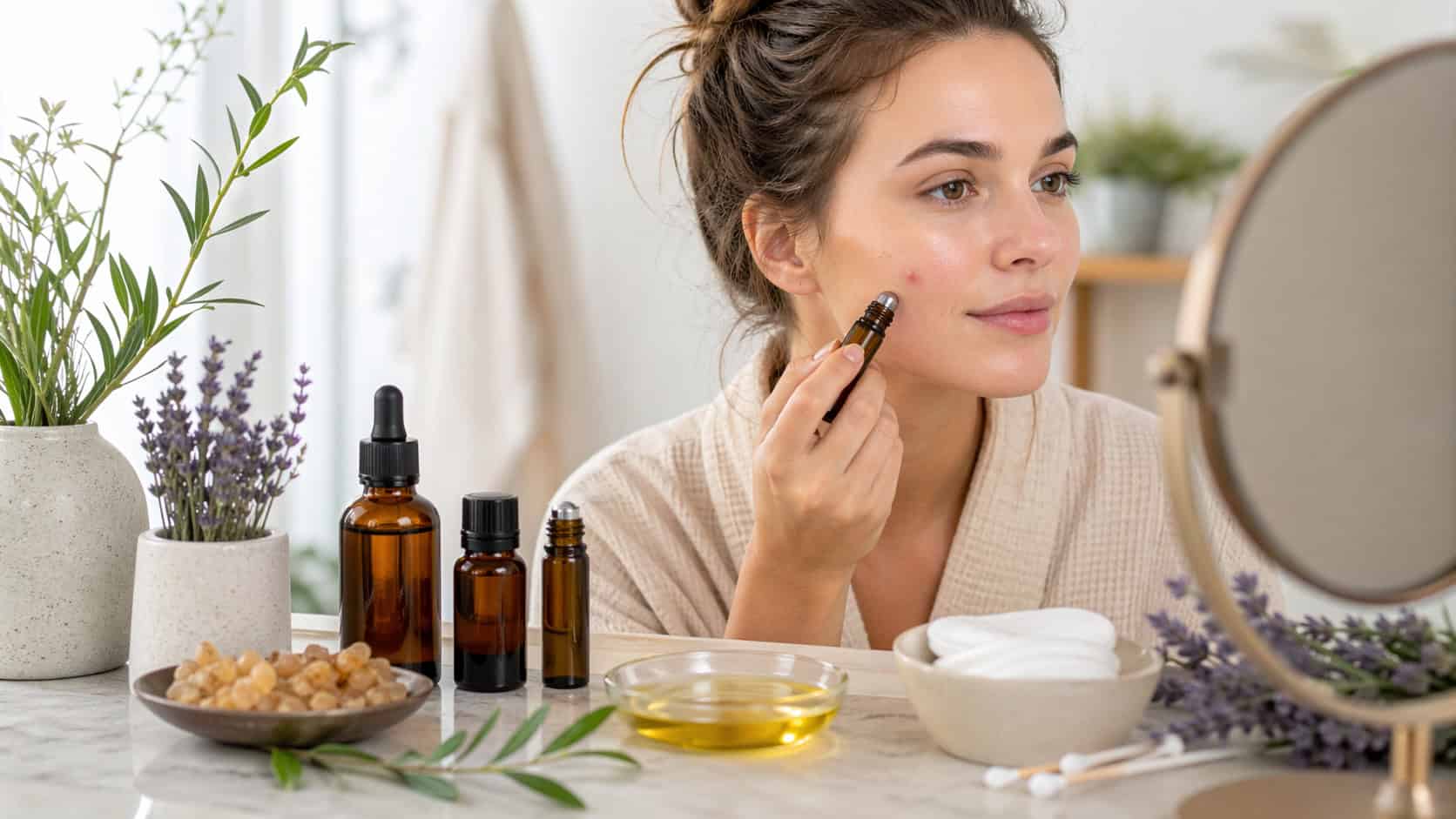
Your skin is your body’s largest organ, and it’s constantly exposed to environmental stressors, bacteria, and the effects of aging. Essential oils have been used in skin care for thousands of years, and modern research is beginning to confirm what traditional practitioners have long observed: certain plant compounds genuinely support skin health.
A 2025 systematic review analyzing 70 studies found that tea tree oil was particularly effective for acne treatment, while lavender and rosemary showed promising anti-inflammatory and anti-aging properties (Frontiers in Medicine, 2025). A separate 2024 scoping review of 29 clinical studies confirmed the potential of essential oils for inflammatory skin conditions including acne, eczema, and psoriasis (Pharmaceuticals, 2024).
This guide covers the best essential oils for common skin concerns: acne and blemishes, aging and wrinkles, general skin health, and irritation. Every recommendation includes specific dilution ratios and application methods, because how you use an oil on your skin matters as much as which oil you choose.
Important: Essential oils are highly concentrated and must always be diluted before applying to facial skin. Never apply undiluted essential oils to your face. If you have a serious skin condition (cystic acne, eczema, psoriasis, rosacea), consult a dermatologist. Essential oils are complementary tools, not replacements for medical dermatological care.
The Best Essential Oils for Skin, Ranked by Concern
For Acne and Blemishes
1. Tea Tree (Melaleuca) – The Blemish Fighter
Why it’s #1 for acne: The most clinically studied essential oil for acne. A randomized double-blind trial found 5% tea tree oil gel was 3.55 times more effective than placebo in reducing total acne lesion count and 5.75 times more effective in improving acne severity (PMC, 2023). Tea tree’s antimicrobial action targets Cutibacterium acnes, the bacterium primarily responsible for inflammatory acne.
How to use it:
- Spot treatment: 1 drop tea tree + small amount of jojoba oil, apply directly to blemishes with a cotton swab
- Facial wash: Add 3-4 drops to your cleanser, use nightly
- Blemish roller: 5 drops tea tree + 3 drops lavender + 10mL jojoba oil in a roller bottle
- Body acne: Add 5-8 drops to your body wash
Expect: Improvement in 4-6 weeks with consistent daily use. Tea tree works more slowly than benzoyl peroxide but causes fewer side effects, such as dryness and peeling.
2. Lavender – The Gentle Healer
Why it works for skin: Lavender’s anti-inflammatory and antimicrobial properties make it versatile for multiple skin concerns. Research on human dermal fibroblasts has shown lavender affects biomarkers related to inflammation and tissue repair. It’s also one of the gentlest oils, making it suitable for sensitive skin when properly diluted.
How to use it:
- General skin care: 2-3 drops in 1 teaspoon jojoba oil, apply as a facial serum
- For blemishes: Apply 1 drop diluted directly to spots
- For minor burns, scrapes, or insect bites: 1-2 drops diluted in aloe vera gel
- Calming mask: 2 drops lavender + 1 tablespoon honey + 1 tablespoon plain yogurt
3. Frankincense – The Skin Rejuvenator
Why it works for skin: Frankincense oil significantly modulated biomarkers related to inflammation and tissue remodeling in human skin cells (Han et al., 2017, PubMed). A 2024 review confirmed its potential for treating inflammatory skin conditions including eczema.
How to use it:
- Anti-aging serum: 3 drops frankincense + 3 drops lavender + 1 tablespoon rosehip seed oil
- For blemishes and scars: 2 drops frankincense + 1 drop tea tree in jojoba oil
- Daily moisturizer booster: Add 2-3 drops to your unscented moisturizer
- For stretch marks: 4 drops frankincense + 3 drops lavender + 2 tablespoons carrier oil
For Anti-Aging and Wrinkles
4. Geranium – The Skin Balancer
Why it works: Geranium helps balance oil production, making it useful for both oily and dry skin. Its astringent properties tighten and tone skin, and its floral aroma makes skin care routines pleasant. It’s also one of the better oils for promoting an even skin tone.
How to use it:
- Toning serum: 3 drops geranium + 2 drops frankincense + 1 tablespoon jojoba oil
- For oily skin: Add 2 drops to your cleanser
- Facial steam: 2 drops geranium + 1 drop lavender in a bowl of hot water, steam face for 5 minutes
5. Rose (Rosa damascena) – The Luxury Skin Oil
Why it works: Rose oil helps balance skin moisture and promotes an even, radiant skin tone. It’s one of the most prized oils in high-end skin care. Its anti-inflammatory properties may help calm redness and irritation.
How to use it:
- Facial serum: 2 drops rose + 2 drops frankincense + 1 tablespoon rosehip seed oil
- Undereye treatment: 1 drop rose in 1 tablespoon jojoba oil, apply gently with ring finger
- Rose is extremely concentrated. Less is more.
Note: Rose oil is one of the most expensive essential oils. A little goes a very long way, and it’s worth the investment for facial skin care.
Read our complete Rose guide →
6. Helichrysum (Helichrysum italicum) – The Regeneration Oil
Why it works: Often called the “immortelle” or “everlasting” oil. Helichrysum is prized for its potential to reduce the appearance of scars, wrinkles, and skin damage. Its anti-inflammatory and antioxidant properties are well-documented in laboratory studies.
How to use it:
- Scar reduction: 2 drops helichrysum + 2 drops frankincense + 1 tablespoon rosehip seed oil. Apply twice daily.
- Anti-aging: Add 2 drops to your nighttime moisturizer
- For bruises: Apply 1-2 drops diluted directly to the area
Read our complete Helichrysum guide →
For General Skin Health
7. Copaiba – The Soothing Support
Why it works: Beta-caryophyllene’s anti-inflammatory properties work through the CB2 receptor to calm skin irritation and redness. Copaiba is mild enough for daily use and blends seamlessly into any skin care routine.
How to use it:
- Add 2-3 drops to your daily moisturizer
- For irritated skin: 3 drops copaiba + 2 drops lavender in 1 tablespoon carrier oil
- Full-body moisturizer: 10 drops per 4oz unscented lotion
Read our complete Copaiba guide →
8. Rosemary – The Circulation Booster
Why it works: Rosemary improves circulation to the skin, which may support a healthy, glowing complexion. The 2025 systematic review noted its anti-inflammatory and anti-aging properties in clinical settings.
How to use it:
- Brightening serum: 2 drops rosemary + 2 drops lemon + 1 tablespoon jojoba oil (photosensitive, use at night)
- Scalp and facial circulation boost: Add to a warm facial compress
CAUTION: Rosemary is not for people with epilepsy. Not for use during pregnancy.
Read our complete Rosemary guide →
Essential Oil Skin Care Recipes
The Everyday Facial Serum
- 4 drops lavender
- 3 drops frankincense
- 2 drops geranium
- 1oz (30mL) jojoba oil
Mix in a dark glass dropper bottle. Apply 3-4 drops to clean skin morning and night. This is a well-rounded serum suitable for most skin types.
The Blemish-Fighting Spot Treatment
- 5 drops tea tree
- 3 drops lavender
- 2 drops frankincense
- 10mL fractionated coconut oil
Mix in a roller bottle. Roll directly onto blemishes morning and night. Results typically visible within 4-6 weeks of consistent use.
The Anti-Aging Night Treatment
- 3 drops frankincense
- 2 drops rose or geranium (rose if budget allows)
- 2 drops helichrysum
- 1oz rosehip seed oil
Mix in a dark glass dropper bottle. Apply to clean face before bed. Rosehip seed oil is rich in vitamin A and essential fatty acids, complementing the essential oils’ anti-aging properties.
The Soothing Irritation Blend
- 3 drops lavender
- 3 drops copaiba
- 2 drops Roman chamomile
- 1oz jojoba oil
For irritated, red, or inflamed skin. Apply gently to affected areas. Do not use on broken skin or open wounds without consulting a healthcare provider.
Skin Care Dilution Guide
Facial skin is more sensitive than body skin. Use lower concentrations.
| Application | Dilution | How Much |
|---|---|---|
| Face (daily use) | 1% | 3 drops essential oil per tablespoon carrier oil |
| Face (targeted treatment) | 2% | 6 drops per tablespoon carrier oil |
| Body (daily use) | 2-3% | 6-9 drops per tablespoon carrier oil |
| Spot treatment | 3-5% | Apply small amount to individual spots only |
| Sensitive skin | 0.5-1% | 1-3 drops per tablespoon carrier oil |
Best Carrier Oils for Facial Skin Care
- Jojoba oil: Closest to skin’s natural sebum. Won’t clog pores. Best all-around choice.
- Rosehip seed oil: Rich in vitamin A and essential fatty acids. Excellent for anti-aging. Light and dry.
- Argan oil: Moisturizing without heaviness. Good for dry skin.
- Fractionated coconut oil: Light, absorbs quickly. Good for oily skin.
- Sweet almond oil: Gentle, affordable. Good for body applications.
Common Skin Care Mistakes with Essential Oils
Applying undiluted oils to the face. This is the #1 mistake. Even gentle oils like lavender can cause sensitization with repeated undiluted use on facial skin. Always dilute.
Using too many different oils at once. If you react to a 7-oil blend, you won’t know which one caused the problem. Start with 1-2 oils and add more gradually.
Expecting overnight results. Skin cell turnover takes 4-6 weeks. Give any new routine at least a month before evaluating whether it’s working.
Ignoring photosensitivity. Lemon, bergamot, lime, and other citrus oils make skin more sensitive to UV light. Use citrus oils in facial care only at night, or avoid sun exposure for 12 hours.
Using essential oils on active eczema or psoriasis flares without professional guidance. While some oils may help these conditions, applying the wrong oil during a flare can make things significantly worse. Consult a dermatologist first.
Skipping the patch test. Always test a new oil on a small area of skin (inside of forearm) 24 hours before applying to your face. Facial skin is more reactive than arm skin, so this is a minimum precaution.
Frequently Asked Questions
Which essential oil is best for acne? Tea tree has the most clinical research supporting its use for acne. A 5% tea tree gel was shown to be significantly more effective than placebo and comparable to benzoyl peroxide with fewer side effects. For a well-rounded approach, combine tea tree (antimicrobial) with lavender (anti-inflammatory and healing) and frankincense (tissue remodeling).
Can essential oils replace my skin care products? They can complement your routine but probably shouldn’t replace everything. A good carrier oil with 2-3 essential oils makes an excellent serum, but you’ll still want a proper cleanser, sunscreen, and any prescription treatments your dermatologist recommends. Think of essential oils as a layer in your routine, not a replacement for it.
Are essential oils safe for sensitive skin? Yes, if you dilute appropriately. Use a 0.5-1% dilution (1-3 drops per tablespoon of carrier oil) and always patch test first. Lavender, frankincense, and copaiba are among the gentlest options. Avoid tea tree at high concentrations on sensitive skin.
Can I use essential oils around my eyes? Use extreme caution. The skin around your eyes is the thinnest and most sensitive on your body. If applying a serum near the eye area, use the lowest possible dilution (0.5%) and keep oils at least half an inch from the eye itself. Frankincense and rose in jojoba oil at very low concentration are common choices for undereye application. Never apply peppermint, eucalyptus, or tea tree near your eyes.
How long until I see results from essential oils on my skin? For blemishes: 4-6 weeks of consistent daily use before meaningful improvement. For anti-aging: 2-3 months for subtle improvements in skin texture and tone. For general skin health, most people notice their skin feels better within 1-2 weeks of using a good carrier oil + essential oil serum. Be patient and consistent.
Get Our Free Essential Oils Reference Guide
A printable quick-reference card covering the top 25 essential oils with their primary uses, dilution ratios, and safety notes. Includes a skin care section.
[Beehiiv signup form will be embedded here]
Our Top Picks for Skin Care
Tea tree, lavender, and frankincense cover the widest range of skin concerns. Tea tree fights blemishes, lavender soothes and heals, and frankincense supports anti-aging and tissue repair.
See Our RecommendationsSave 25% with a wholesale accountWe may earn a commission if you purchase through our links.